
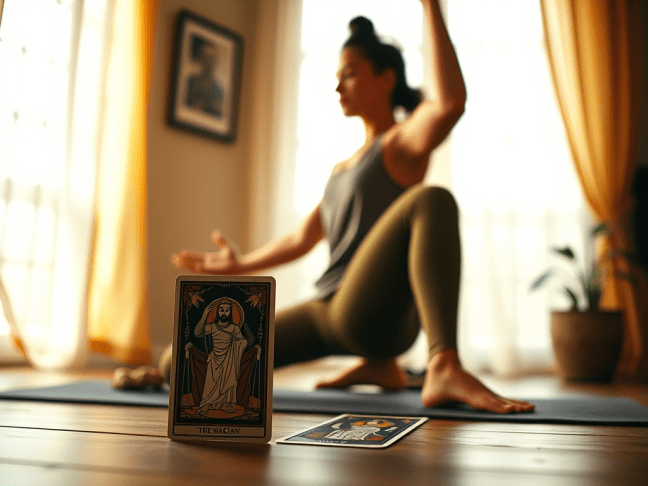
Can tarot be of any help if you want to practice yoga?

One of the aspects tarot readers love about this practice is its versatility. You can use tarot to predict your future, learn about your present, and improve your daily living.

But can you guide the practice of another discipline such as yoga through tarot?

Tarot as an oracle

Major and minor arcana in tarot have different energies and symbols. Depending on your deck, you may have extra clues to apply your readings to a given circumstance.

Take the magician as an example. The card symbolizes the manifestation of an intention into reality. In Love readings, it shows a dedicated lover that makes you feel amazing. But it can also be read as the archetype of masculinity and hard work.

Such a variety of meanings are linked to a single essence: focus and personal power.

You can see that archetype in daily living, almost every day. When a reading has the magician as its main focus, it’s an oracle drawing your attention to this aspect of life. If you respond by trusting yourself and doing your best, you’ll probably have a different view of otherwise routinary or sometimes chaotic events in life.

That insight you gain by changing your view is what makes an oracle so powerful.

Oracles for yoga and their applications

There are hundreds of oracles out there, and some can be applied to yoga. Tarot itself can be helpful because both practices share a common ground.

They both encourage personal growth and mindfulness. Moreover, there are tarot cards such as the magician, which promote the alignment of mind and body.

Integrating tarot into your yoga practice can gradually deepen your understanding of each pose. For instance, when you’re making the Warrior Pose I embodied as The Magician, your mind can be centered on much more than holding the stance. You’re internalizing grounded strength, upward aspiration, and the positive effects of combining your power and concentration.

Set your yoga intention with tarot cards

Have you ever drawn a tarot spread to set your intention before a yoga session? You can use a single card or a few to practice different stances and get your mind focused on an archetype.

In some cases, it can take your practice to completely new levels.

For instance, the corpse pose in yoga can help you relax and it is great to promote quality sleep. But what if you link this pose to The Death tarot card? It prompts the need to quietly gather strengths before facing big life changes. It may help you let go if something you enjoy is near its end.

There are poses linked to each tarot card, and you can use them as an experienced yoga practitioner or a newcomer. Discover the creativity of bringing tarot and yoga together and draw your next tarot spread in a completely new way.

Wondering how you can do it? “Yoga Through Tarot Cards: 50 Embodied Practices Inspired by the Major & Minor Arcana” is a publication by professional yoga teacher and tarot reader, Lou Thomas you can obtain here. It will guide you through the deep interactions between tarot and yoga and how it can strengthen your yoga practice.

After reading and applying its creative insights, you will gain a completely new view of an ancestral practice that makes you stay connected with yourself and the rest of the world.

https://www.adleinternational.biz

Simple Everyday Practices To Boost Your Brain

In today’s fast-paced world, you may find yourself running from one task to the other. There is just so much to do and so little time to do it in. As such, it is easy to become overwhelmed and distracted by the constant bombardment of information and demands on your time. This can lead to fatigue, lack of focus, and even mood swings.

Fret not, though! There are many simple practices you can instill in your everyday life that will help you navigate the complexities of the modern world. These practices might seem trivial, but they add up over time to improve your brain health and your overall well-being. Let’s take a look at some of them below.

1) Start Your Day with Exercise

In the past decade or so, most people have become aware of the incredible positive impacts of exercising. It is not only a boon for your physical health but also your mental and emotional health. When you get some physical movement first thing in the morning, it can help wake up your brain and provide an energy boost. Even something as simple as jogging can help release feel-good hormones and improve your mood and focus.

2) Eat A Healthy Breakfast

Probably everybody’s parents taught them the value of a healthy breakfast. It not only fuels your brain for the entire day but also improves your mood. Foods like whole grains, fruits, and nuts provide important vitamins and minerals that can improve memory and focus. So, make sure you eat the right breakfast no matter how busy your schedule is.

3) Take Regular Breaks

We, humans, are biological beings. Even though we sometimes think of ourselves as machines, the truth doesn’t change. As such, we need breaks from time to time to recharge physically and mentally. So, it’s a good idea to take short breaks throughout the day. This can help improve focus and reduce stress. You could try taking a five-minute break every hour to stretch, meditate, or take a short walk.

4) Stay Hydrated

Water is an essential ingredient of good mental health that a lot of people underestimate. Did you know that even mild dehydration can cause headaches and lead to fatigue? This is why it is important to drink plenty of water throughout the day. It can help keep your brain hydrated and improve cognitive function.

5) Practice Mindfulness

Mindfulness is one of the best spiritual practices you can incorporate into your daily life. Like meditation and yoga, it can reduce stress and improve your focus. It can also help keep your attention in the present moment, which can improve your productivity and happiness. You can try practicing mindfulness for a few minutes daily and slowly increase the duration.

6) Challenge Your Brain

Like any other muscle in your body, your brain becomes stronger when you put it through challenges. This is why engaging in mentally stimulating activities is a great way to enhance your cognitive functions. To that end, you could spend some time every day solving puzzles or learning a new skill. This can help improve memory and focus.

These are just some of the daily practices you can instill in your life to change your brain for the better. In his book, “Change Your Brain Every Day: Simple Daily Practices to Strengthen Your Mind, Memory, Moods, Focus, Energy, Habits, and Relationships,” Dr. Daniel G. Amen talks about many more effective daily habits that can help you master your mind, boost your memory, and make you feel happier, healthier, and more connected to those you love.

15 Natural Remedies For Migraine Headaches

15 Natural Remedies For Migraine Headaches

Anyone who has ever suffered a migraine headache knows how terrible it can be. The pain, nausea, and sensitivity to light and sound you experience during a migraine can make even simple tasks seem herculean. On top of it, sometimes, these types of headaches can last for two to three days, which can drastically decrease one’s quality of life.

Fortunately, there are many powerful and effective migraine drugs available on the market. And doctors readily prescribe them to anyone suffering from this condition. However, as millions of people around the globe have discovered, these drugs come with side effects. In some cases, the side effects are so severe, that people have to stop treatment altogether.

So, what should you do if you’re suffering from migraine headaches and are looking for safer ways of treatment? Well, that’s where natural remedies come in.

1) Butterbur

This might sound like a delicious beverage but it is actually a herb that grows throughout Europe. It has also been used for centuries to treat migraine headaches. In fact, even scientists have recommended using this herb to reduce the severity and frequency of migraines. If you do choose to use Butterbur, make sure you get a high-quality supplement that does not have some of the harmful chemicals present in the raw plant.

2) Ginger

Ginger has been a staple of traditional medicine for thousands of years. Its anti-inflammatory properties are quite popular and it is the go-to natural remedy for a lot of people in eastern countries. Its healing properties also make it the perfect choice for treating migraine headaches. What’s great about ginger is that it can be consumed in a variety of ways. You could make tea out of it, consume it in powder form, or even take ginger supplements.

3) Feverfew

Feverfew is a flowering herb that looks like a daisy. It has been used for centuries to treat migraine headaches, stomach aches, insect bites, and even fertility problems. It is said that feverfew reduces inflammation in the body and prevents the constriction of blood vessels in the brain. This is what provides relief from migraine headaches. However, scientists are still studying its effects and are yet to come to a conclusion on its effectiveness.

4) Essential Oils

Essential oils are one of the most popular forms of alternative treatment in today’s world. People from all walks of life have made them a part of their daily lives for a plethora of reasons. Essential oils have been found effective against stress, anxiety, chronic pain, headaches, sleep deprivation, nausea, and so on. So, you can definitely use them to treat your migraine headaches. Oils such as lavender and peppermint are quite effective at reducing the symptoms of migraines.

5) Yoga and Meditation

Yoga and meditation are both ancient spiritual practices that are still popular today. If you make these practices a part of your daily life, you can greatly reduce the frequency and severity of your migraine headaches. These practices work by reducing stress and tension throughout your body and can also help improve sleep, thereby keeping you in a more relaxed state.

These are just some of the natural remedies that can help you treat migraine headaches. There are many more you can turn to, depending on your preference and other health factors. Dr. Jay Cohen’s “15 Natural Remedies for Migraine Headaches” is a great book you can check out to learn more about these remedies.