Tarot Imagery: A Transformative Mirror to the Soul

Long before tarot was considered a divination tool, it was aimed at figuring out people and situations to understand better what happens and why. It has always been an excellent mirror to the soul, and the intricate tarot imagery serves as a key to deciphering those hidden patterns, sparking curiosity and a thirst for knowledge.

After reading this piece, you will understand why images in tarot are so important and why some tarot readers use different decks with varying designs.

Unveiling the power of Tarot imagery and the unconscious mind

Archetypes, as described by psychologist Carl Jung, are universal patterns that correspond to states of the human psyche. These primordial images are constantly found in myths and fairy tales because they are part of a collective unconscious. What tarot does with these archetypes is represent them in a card with deep meanings.

A combination of cards in a tarot shuffle reveals associations of different archetypes and their relationships. So, instead of reading them at first sight, why don’t we take a bit more time to examine the universal pattern they convey?

Doing so can help you transition from unconscious to conscious. Your inner world unfolds, and more than mere events and predictions, you gain insight into the patterns that hide within the fog of a complex mind and society.

But then, the same imagery that helped you figure out tarot readings may become a limited view because they often show an angle of a complex archetype that cannot be reduced to a simple image. That’s why most professional tarot readers buy additional decks with optional imagery. Connecting with new tarot images can help deepen your readings and understand the complexity of the archetype beyond a single representation.

How tarot reveals patterns and elevates consciousness

In a tarot card reading, each shuffle represents an intermediary between our inner world and the rational perception that turns everything into facts and figures. We can either go directly to events and the answers we’re looking for or give shape to emotions and thoughts that would otherwise remain hidden in the unconscious mind.

But even if you don’t have time for insightful reading and want a clear answer to show up and go on with your life, remember that there are thousands of possibilities behind each concise answer in tarot. What tarot shows are not hard facts but energies on the move, and images are a limited representation of such energies.

How to deepen tarot meanings and expand on each archetype

Most people start by learning tarot meanings and combinations with a classic maze such as Rider-Waite or Marseille. That’s perfectly fine because they contain many hidden gems readers will encounter in time.

But after you get used to them, why don’t you challenge yourself with a new deck with alternative imagery? Explore how such new imagery expands your understanding of the archetype, achieving slight modifications to your readings.

Once you get acquainted with a second maze, it will be easier to remember the representation of the same card in a different maze. Examine how such deepening of the arcane can change your understanding of the shuffle.

And if you want to go beyond representations, why don’t you try something new? Use a tarot maze with symbolic representations of each archetype instead of the usual scenery with characters and concise messages. Try these mazes when you feel ready for them, and experience how they expand your connection with your cards.

After a while, you will better understand archetypes beyond a simple representation, using different images to explore the various angles of each card. Continue practicing, and don’t forget to take extra time to investigate and ask profound and insightful questions.

Tarot dreams: How to interpret your dream when a card shows up

Tarot dreams: How to interpret your dream when a card shows up

Some of us have had a dream with a tarot card, which sometimes strikes us as a complete mystery. How can we interpret these dreams?

Whether you’re a consultant or a reader, tarot dreams often carry potent messages. However, these are more relevant if you have interacted with tarot. Contrary to that, if you simply saw a tarot card in a movie scene and then had a dream of it, the meaning can be biased and more complicated to interpret.

In this article, we will uncover the key steps you can take to interpret your dreams or help other people know what their tarot dreams are trying to reveal.

A basis for tarot dream interpretation

When interpreting tarot dreams, you must first ask whether they reflect a message from the past, present, or future. The answer depends on where the card or spread is placed on your perspective as a dreamer:

  • On your left side: The card or spread refers to your past. It may refer to unresolved issues or past events that you need to consider.
  • At the center: The card or spread refers to the present. It relates to current challenges, influences, or opportunities.
  • On your right side: The card or spread refers to your immediate future. It usually translates to a few days or weeks.

For example, finding The Emperor on your left in a dream might show that you have unresolved issues with a paternal figure or your boss. On the other hand, The Empress on your right side might indicate a future influence or an upcoming encounter with your mother or a mother-in-law.

Relevant meanings and how to find them in dreams

Tarot cards have different meanings, and it’s natural to feel confused with many interpretations. But remember, dreams are deeply involved with your inner self. The card’s message most likely aligns with your heart and the meaning closest to your essence and personality.

Even if you’re familiar with several definitions, the most meaningful one resonates with you emotionally. Trust your intuition and consider other events in the dream that might provide context for the spread.

For instance, the High Priestess is linked to intuition, spiritual wisdom, and secrecy. Imagine a dream where someone else asks you many questions or prompts you to speak, and the High Priestess shows up at the table on your right. The dream suggests that you should be careful with the information you disclose in the following days and follow your intuition if someone seems untrustworthy.

The intrinsic plot twist of dreaming

One crucial factor to remember when interpreting tarot dreams is that they are not always straightforward. The subconscious mind hides uncomfortable realities in symbols and events that will be easier to handle. Thus, a seemingly beautiful dream may sometimes carry unsettling messages and vice versa.

An example is The World and The Death. If someone who’s severely ill has a dream with The Death card, we might initially think of a grievous outcome. However, it usually means going through hardship but finding a profound change after a while. In contrast, The World card in this context means happiness and fulfillment, but in heaven or a mystical world. It is a happier card on its outer layer, but it can also mean the culmination of something, including one’s lifespan.

Tarot dreams can be fascinating and mysterious. But with the proper perspective and an open-minded approach, you can find more profound messages from your subconscious mind. So, next time you dream with tarot cards, make notes as soon as possible to remember the card’s location and the key events that provide context to your reading.

Some of us have had a dream with a tarot card, which sometimes strikes us as a complete mystery. How can we interpret these dreams?

Whether you’re a consultant or a reader, tarot dreams often carry potent messages. However, these are more relevant if you have interacted with tarot. Contrary to that, if you simply saw a tarot card in a movie scene and then had a dream of it, the meaning can be biased and more complicated to interpret.

In this article, we will uncover the key steps you can take to interpret your dreams or help other people know what their tarot dreams are trying to reveal.

A basis for tarot dream interpretation

When interpreting tarot dreams, you must first ask whether they reflect a message from the past, present, or future. The answer depends on where the card or spread is placed on your perspective as a dreamer:

  • On your left side: The card or spread refers to your past. It may refer to unresolved issues or past events that you need to consider.
  • At the center: The card or spread refers to the present. It relates to current challenges, influences, or opportunities.
  • On your right side: The card or spread refers to your immediate future. It usually translates to a few days or weeks.

For example, finding The Emperor on your left in a dream might show that you have unresolved issues with a paternal figure or your boss. On the other hand, The Empress on your right side might indicate a future influence or an upcoming encounter with your mother or a mother-in-law.

Relevant meanings and how to find them in dreams

Tarot cards have different meanings, and it’s natural to feel confused with many interpretations. But remember, dreams are deeply involved with your inner self. The card’s message most likely aligns with your heart and the meaning closest to your essence and personality.

Even if you’re familiar with several definitions, the most meaningful one resonates with you emotionally. Trust your intuition and consider other events in the dream that might provide context for the spread.

For instance, the High Priestess is linked to intuition, spiritual wisdom, and secrecy. Imagine a dream where someone else asks you many questions or prompts you to speak, and the High Priestess shows up at the table on your right. The dream suggests that you should be careful with the information you disclose in the following days and follow your intuition if someone seems untrustworthy.

The intrinsic plot twist of dreaming

One crucial factor to remember when interpreting tarot dreams is that they are not always straightforward. The subconscious mind hides uncomfortable realities in symbols and events that will be easier to handle. Thus, a seemingly beautiful dream may sometimes carry unsettling messages and vice versa.

An example is The World and The Death. If someone who’s severely ill has a dream with The Death card, we might initially think of a grievous outcome. However, it usually means going through hardship but finding a profound change after a while. In contrast, The World card in this context means happiness and fulfillment, but in heaven or a mystical world. It is a happier card on its outer layer, but it can also mean the culmination of something, including one’s lifespan.

Tarot dreams can be fascinating and mysterious. But with the proper perspective and an open-minded approach, you can find more profound messages from your subconscious mind. So, next time you dream with tarot cards, make notes as soon as possible to remember the card’s location and the key events that provide context to your reading.

Celebrate your holidays with tarot: Black Friday deals you can’t miss

In Tarot Place, we believe tarot is much more than just a set of cards. It is a tool to connect with the unconscious mind and deepen our self-awareness. In the right hands, it also offers valuable insights into the past, present, and future.

If you are learning to read tarot or are a seasoned tarotist, a beautiful deck is one of the best Christmas presents. Using an alternative set unlocks new layers of interpretation, enriching your views and readings.

Buying a new deck provides a new perspective on what you already do. That’s why we’ve curated incredible offers for the holiday season.

Exclusive Black Friday deals at The Tarot Place

Our store in Tarot Place has now made available a new offer coupon you can activate on your checkout. From November 17 until December 3, you’ll have a 15% discount on any sale over $50.

Use the code CYBER2024 at checkout to enjoy this holiday discount. It’s our gift for Christmas.

But after Christmas, you’ll get another deal to start the new year with a new oracle or tarot deck. You’ll have a 25% discount on any sale over $75 from December 25 to December 31.

Enjoy this special offer with the code ENDOFSEASONDEALS24. Use it at checkout before paying and save big for New Year’s Eve!

Tarot gift ideas for Christmas and New Year

Searching for the perfect gift for yourself or a loved one? Here’s what The Tarot Place has to offer this holiday season:

  • Basic tarot decks: The basic decks, including the Rider-Waite version, are here in different sizes and qualities in case you’re looking to renew your older set of cards. It is also the perfect gift as a starting set for someone you love.
  • Artsy and thematic tarot decks: A second deck can give you a new perspective based on the art in each card. Our product list includes thematic tarot decks like the Beetlejuice and Dracula decks. You’ll also have artsy alternatives like the Tarot of the Cosmic Seed.
  • A variety of oracles: These cards are perfect for guiding readings and enhancing meditation insights. They also follow themes such as the Sacred Spirit Oracle and the Buddhism Oracle.
  • Limited and special editions: Explore rare gems like the Dalí Tarot, a stunning collection created by Salvador Dalí himself.

Why choose The Tarot Place for your spiritual journey

When you decide to buy a new Oracle or tarot deck, there are plenty of marketplaces and online stores to choose from. But here’s what differentiates The Tarot Place:

  • A curated list with the best items. We are not competing with others and prefer quality over quantity. We’re not selling a tarot deck that does not resonate with intuition.
  • Updated listings. We keep track of our stock and readily update our listings when an item becomes unavailable. We won’t notice an item is out of stock after you buy it.
  • Rapid and secure delivery. Your product will arrive securely at your door, and we’ll ensure the delivery is as swift as possible. No surprises.

By choosing us, you trust a marketplace that values your journey and supports your connection to the spiritual world. Now you have your discount coupons, how are you planning to use them?

Top Tarot Decks for Holiday Gifting

In Tarot Place, we believe tarot is much more than just a set of cards. It is a tool to connect with the unconscious mind and deepen our self-awareness. In the right hands, it also offers valuable insights into the past, current, and future.

If you are learning to read tarot or are a seasoned tarotist, a beautiful deck is one of the best Christmas presents. Using an alternative set unlocks new layers of interpretation, enriching your views and readings.

Buying a new deck provides a new perspective on what you already do. That’s why we’ve curated incredible offers for the holiday season.

Exclusive Black Friday deals at The Tarot Place

Our store in Tarot Place has now made available a new offer coupon you can activate on your checkout. From November 17 until December 3, you’ll have a 15% discount on any sale over $50.

Use the code CYBER2024 at checkout to enjoy this holiday discount. It’s our gift for Christmas.

But after Christmas, you’ll get another deal to start the new year with a new oracle or tarot deck. You’ll have a 25% discount on any sale over $75 from December 25 to December 31.

Enjoy this special offer with the code ENDOFSEASONDEALS24. Use it at checkout before paying and save big for New Year’s Eve!

Tarot gift ideas for Christmas and New Year

Searching for the perfect gift for yourself or a loved one? Here’s what The Tarot Place has to offer this holiday season:

  • Basic tarot decks: The basic decks, including the Rider-Waite version, are here in different sizes and qualities in case you’re looking to renew your older set of cards. It is also the perfect gift as a starting set for someone you love.
  • Artsy and thematic tarot decks: A second deck can give you a new perspective based on the art in each card. Our product list includes thematic tarot decks like the Beetlejuice and Dracula decks. You’ll also have artsy alternatives like the Tarot of the Cosmic Seed.
  • A variety of oracles: These cards are perfect for guiding readings and enhancing meditation insights. They also follow themes such as the Sacred Spirit Oracle and the Buddhism Oracle.
  • Limited and special editions: Explore rare gems like the Dalí Tarot, a stunning collection created by Salvador Dalí himself.

Why choose The Tarot Place for your spiritual journey

When you decide to buy a new Oracle or tarot deck, there are plenty of marketplaces and online stores to choose from. But here’s what differentiates The Tarot Place:

  • A curated list with the best items. We are not competing with others and prefer quality over quantity. We’re not selling a tarot deck that does not resonate with intuition.
  • Updated listings. We keep track of our stock and readily update our listings when an item becomes unavailable. We won’t notice an item is out of stock after you buy it.
  • Rapid and secure delivery. Your product will arrive securely at your door, and we’ll ensure the delivery is as swift as possible. No surprises.

By choosing us, you trust a marketplace that values your journey and supports your connection to the spiritual world. Now you have your discount coupons, how are you planning to use them?

https://www.adleinternational.biz

Exploring the Symbolism of Water in Life

More than a life symbol: The deep meanings behind water

More than half the human body is made up of water. Apart from flowing through our veins, this mystical fluid has long transcended time as a symbol of life, connection, and emotions.

The deep meanings hiding behind its transparent mass extend far and wide into different aspects of life. Breaking water marks the start of birth, running water symbolizes letting go, restless waters are linked to emotional turmoil. But when water is calm, its reflection shows reality clearly and without filters.

With such diverse meanings, this element deserves more than a simple mention in our tarot and oracle readings. So, let’s go through some applications of water symbology that people usually overlook.

Basic understanding of water as a symbol

We don’t need a solid background in tarot reading and esoteric symbols to be acquainted with the usual meanings of water:

  • Water is associated with cleansing and renewal. It wipes out negative energies and leaves burdens in the past, allowing for a fresh start.
  • Water is deeply associated with the emotional world and intuition. It is the element behind the Suit of Cups in tarot and symbolizes relationships, emotional states, and psychic awareness.
  • When water energies are skillfully directed, they promote emotional restoration. It is a symbol of gentle healing as opposed to aggressive or forceful attempts to correct flaws and defects.
  • When water is calm, it serves as a reflection or mirror. It helps us see deeper truths, offering clarity and insight into both our inner and outer worlds.

Diving deeper into its applications

Water meanings listed above are elementary but equally powerful. However, there are more profound meanings once we understand the basics:

  • Water as transformation and alchemy: This element plays a fundamental role in ancient magic. In the alchemical process, water breaks down rigid structures allowing for change and transformation. It promotes refinement and enlightenment to materials and our own ego.
  • Water as an eternal cycle: Water continuously moves through evaporating, condensing, falling, and flowing. This fact has a deep meaning to it. It symbolizes the eternal cycle of life, death, and rebirth. It is also a reminder of impermanence and gives us the strength to let go.
  • Water as a boundary or crossing point: When depicted as a mass of water, as in a lake or ocean, it also marks a boundary for continents, people, and civilizations. Moreover, it’s a crossing point to our inner self, the subconscious mind, and everything that lies deep within.

We could endlessly explore the meanings of water, adding layer after layer of new depths. Entire books can be published to cover the topic, which is why Rebecca Campbell has recently devoted her most recent oracle to delve into the topic.

Her “Healing Waters Oracle: A 44-Card Deck and Guidebook” can be a good start if you want to explore the deep meanings of water applied to your inner self and growth. The guidebook offers not only a list of meanings but also insights into the esoteric applications of water, a basic element linked to life itself.

Can tarot be of any help if you want to practice yoga?

One of the aspects tarot readers love about this practice is its versatility. You can use tarot to predict your future, learn about your present, and improve your daily living.

But can you guide the practice of another discipline such as yoga through tarot?

Tarot as an oracle

Major and minor arcana in tarot have different energies and symbols. Depending on your deck, you may have extra clues to apply your readings to a given circumstance.

Take the magician as an example. The card symbolizes the manifestation of an intention into reality. In Love readings, it shows a dedicated lover that makes you feel amazing. But it can also be read as the archetype of masculinity and hard work.

Such a variety of meanings are linked to a single essence: focus and personal power.

You can see that archetype in daily living, almost every day. When a reading has the magician as its main focus, it’s an oracle drawing your attention to this aspect of life. If you respond by trusting yourself and doing your best, you’ll probably have a different view of otherwise routinary or sometimes chaotic events in life.

That insight you gain by changing your view is what makes an oracle so powerful.

Oracles for yoga and their applications

There are hundreds of oracles out there, and some can be applied to yoga. Tarot itself can be helpful because both practices share a common ground.

They both encourage personal growth and mindfulness. Moreover, there are tarot cards such as the magician, which promote the alignment of mind and body.

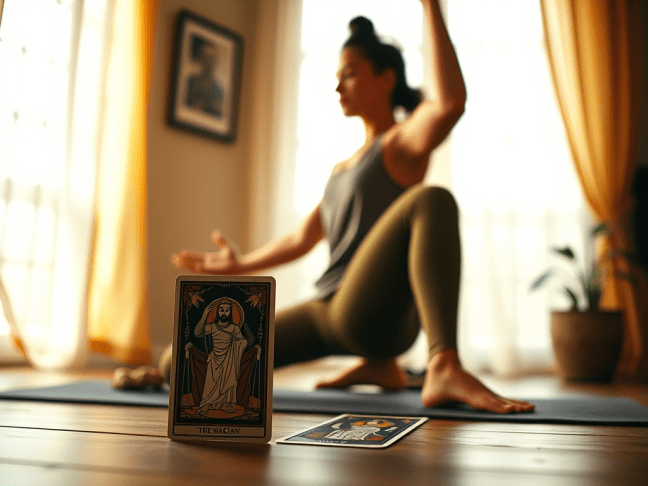
Integrating tarot into your yoga practice can gradually deepen your understanding of each pose. For instance, when you’re making the Warrior Pose I embodied as The Magician, your mind can be centered on much more than holding the stance. You’re internalizing grounded strength, upward aspiration, and the positive effects of combining your power and concentration.

Set your yoga intention with tarot cards

Have you ever drawn a tarot spread to set your intention before a yoga session? You can use a single card or a few to practice different stances and get your mind focused on an archetype.

In some cases, it can take your practice to completely new levels.

For instance, the corpse pose in yoga can help you relax and it is great to promote quality sleep. But what if you link this pose to The Death tarot card? It prompts the need to quietly gather strengths before facing big life changes. It may help you let go if something you enjoy is near its end.

There are poses linked to each tarot card, and you can use them as an experienced yoga practitioner or a newcomer. Discover the creativity of bringing tarot and yoga together and draw your next tarot spread in a completely new way.

Wondering how you can do it? “Yoga Through Tarot Cards: 50 Embodied Practices Inspired by the Major & Minor Arcana” is a publication by professional yoga teacher and tarot reader, Lou Thomas you can obtain here. It will guide you through the deep interactions between tarot and yoga and how it can strengthen your yoga practice.

After reading and applying its creative insights, you will gain a completely new view of an ancestral practice that makes you stay connected with yourself and the rest of the world.

https://www.adleinternational.biz

Creating a safe environment: How to cultivate well-being in the workplace

Some people spend most of the day at work. But even if it’s just a few hours with your co-workers, it’s easier to do so in a comfortable and safe place.

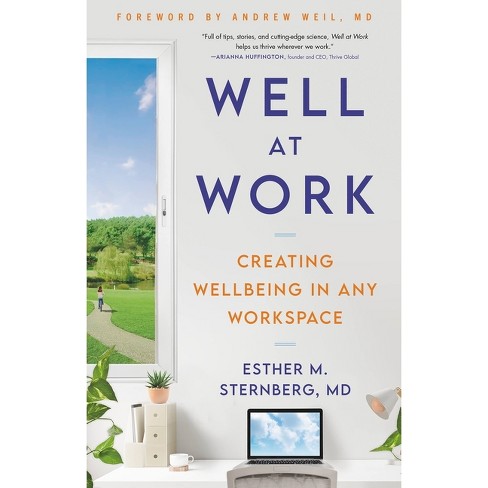
Workplace safety and wellness are critical to effective work performance. That’s the focus of the book “Well at Work: Creating Wellbeing in Any Workspace“.

Whether in the role of boss or employee, we can do many things to improve the work environment. But keep in mind that, like a plant, well-being in the workspace requires ongoing care, as you’ll see below:

Choose seeds and nurture the roots of wellness

A big tree grows from a small seed and is founded on its roots. In the workplace, the seed of wellness is mental health, and the root is the commitment to maintain it.

Once we learn to cope with stress, we will be able to do so at work and everywhere else. Communication skills make us more assertive in achieving our goals. All of this contributes to feeling fulfilled and happy.

Mental health programs and workshops are very useful for this. A coaching session or something as simple as a self-esteem session can make all the difference.

But it is also important for employees to be willing and collaborative. This is a two-way job.

Recognize the right nutrients: light and water

Following the comparison with gardening, a great tree thrives on an adequate supply of light and water. In work wellness, the main nutrients are ongoing improvement and personal recognition.

By ongoing improvement, we want to expand our skillset and learn. If we contribute to it every day, it makes us feel more confident.

Employers can help in the process by providing training opportunities. But there is also self-learning, which is very important to keep growing.

On the other hand, continuous personal recognition is also important. That is, constantly recognizing the positive fruits of our work. By doing so, we can keep up our motivation and inspire our employees.

There are two types of recognition: from ourselves and from others. Everyone makes mistakes. Instead of pointing them out, let’s adopt a positive culture. Let’s see and celebrate our successes.

Sometimes you need to prune and spray for pests

A third important component of growth is to evaluate and make changes. This applies to both gardening and creating your workspace.

First of all, we have feedback, which helps us pinpoint potential improvement. Providing these recommendations constructively makes them easy to follow and contributes to everyone’s well-being.

Secondly, we have the identification of workplace pests: work-related stress. It is normal to feel stress, and some jobs are more complex than others.

But can we do anything to reduce it? What strategy can facilitate the work and accelerate the results?

Burnout is a common problem in some stressful workplaces. It can often be avoided with something as simple as learning to delegate and working as a team.

Conclusion

Cultivating a safe and comfortable workspace is a slow and ongoing process. However, just like a large tree that bears shade and fruit, it is well worth the effort.

To do this we will need strong seeds and roots, by working on mental health. We must provide the right nutrients, including training and personal recognition. Then, pruning and spraying are necessary through feedback and correction of work-related stress.

When Memories Fade: The Unseen Toll of Alzheimer’s on Caregivers

Most of us can empathize with the daunting task of living with a relative afflicted by Alzheimer’s. But very few truly comprehend what it involves and how it feels.

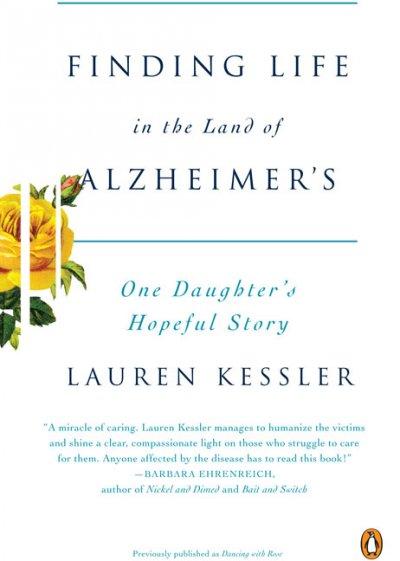
There’s no one better than an actual caregiver to tell us about it, as in the book “Finding Life in the Land of Alzheimer’s: One Daughter’s Hopeful Story.”

Far from adopting a gloomy outlook, Lauren Kessler offers us an uplifting and heartfelt narrative that shares a compassionate light on dementia.

Indeed, caring for a relative with Alzheimer’s is a herculean undertaking that many children and grandchildren don’t choose voluntarily. The disease does not come knocking at the door but barges into our lives uninvited and without concession.

That’s why it’s paramount to safeguard our mental health while in this endeavor.

Sacrifices for the greater good

Alzheimer’s is like an uninvited intruder that completely changes family dynamics.

One could say that the Alzheimer’s patient is the sufferer. However, the entire nuclear family takes the hit as well. Supporting loved ones with this debilitating disease entails three types of sacrifice:

  • An emotional sacrifice: Certainly, watching your father, mother, uncle, or grandparent succumb to the clutches of Alzheimer’s disease is a heart-wrenching ordeal. Seeing their functions deteriorate is frustrating, much more so if you can’t communicate. At some point, you may suppress your emotions, and your role becomes only that of a caregiver.
  • A physical sacrifice: Caregivers also have a physical burden, especially in the advanced stages of the disease. Moving patients, transporting them, enduring sleepless nights, and coping with ceaseless stress can affect your health.
  • A financial sacrifice: Alzheimer’s is also a financial quagmire. In addition to medications and doctor’s appointments, caregivers sometimes have to sacrifice their formal work. Often it is, in itself, a full-time job.

But does it have to be this way?

Efficient organization among relatives and caregivers reduces the burden considerably. Granted, not everyone may feel the same depth of compassion. But it is also true that every caregiver deserves respite, regardless of their devotion and love for their relative.

The cry for help

The rigors of living with Alzheimer’s disease can have a profound impact.

A study published in the Clinical Gerontologist Journal followed 226 Alzheimer’s patients and their families for five years. At the end of the study, 60% of the caregivers showed symptoms of depression.

These symptoms worsened over the years. And once depressed, less than 10% of the caregivers improved their symptoms. That is why you should seek assistance before the weight of the burden spreads to other family members.

There are ten telltale symptoms of caregiver stress:

  • Denial, as they most likely assume that the illness is not that serious.
  • Anger, sometimes directed toward other family members, the caregiver himself, and even the person with dementia.
  • Social isolation, as they no longer enjoy the activities they used to love.
  • Anxiety about everyday situations, and that which could happen in the future.
  • Sadness, which often manifests as indifference or lack of energy.
  • Insomnia, as even sleep becomes stressful and nightmares may occur.
  • Irritability, with emotional reactions becoming much more exaggerated.
  • Lack of concentration, especially on complex tasks, and problem-solving difficulties.
  • Health problems, such as getting sick more often or developing more serious, chronic ailments.

If you experience these symptoms, start taking action to mitigate stress.

Take a realistic view of the disease. Evaluate what you can do and know your limitations. If you have conflicting feelings, the first step is to accept them. Then, talk about them with someone you feel comfortable with.

Seek out a support group or health professional and be sure to ask for help. There are many online resources, support groups, and places to go for help. Take your time, and explore your available options with a healthcare expert. Remember that help is always within reach.

https://www.adleinternational.biz

The mind unveiled: Explore the depths of your brain

The enigmatic realm of the brain perplexed philosophers and scientists for millennia. That’s the topic covered by the celebrated book “We Are Our Brains: A Neurobiography of the Brain, from the Womb to Alzheimer’s.” 

Today, we have more tools and technology to unravel this cosmic conundrum, But many questions remain unanswered. In some cases, space exploration might seem easier than understanding our brains.

Still, science has made some impressive leaps and bounds, and today, we have fascinating data on brain function. Here are just a few of those thrilling brainy tidbits.

Brain and behavior across different life stages

At birth, the brain has approximately 100 billion neurons. Thus, the grand pregnancy marathon requires producing over 250,000 nerve cells per minute.

What happens after that?

The child’s brain

Right from the start, the brain is one of the most demanding organs. And it continues to be so throughout childhood and adolescence.

It gradually gives rise to a defined personality, a distinct personality, very particular tastes, and a highly variable set of talents and skills.

Brain changes through adolescence

However, the most radical transformations occur during adolescence. Hormones waltz onto the scene and modulate nerve interactions. The pre-frontal cortex transforms and develops further.

And there’s a societal rollercoaster that brings new pressures and experiences upon us. It is the perfect recipe to awaken the seeds of rebellion in the search for one’s own identity.

The brain in adulthood

And then adulthood arrives. Contrary to popular belief, it is not a snooze fest. The brain continues to change during this stage. That’s neural plasticity, and it never stops.

We keep producing new nerve cells and forging fresh connections. It is a perfect time to develop our full potential. But some of us stumble into an identity crisis, especially if we haven’t explored our talents and passions in life.

Seniors and cognitive decline

After hitting the golden years, the brain does not behave as many people think. Despite cognitive decline, old age is a time of consolidation.

All the experience we have accumulated over a lifetime becomes our little treasure trove of wisdom. It is a testament to the brain’s ability to grow and develop.

The brain’s role in health and disease

Over the years, the brain is subject to one wave of neurotransmitters after another. Sometimes, they work together as a symphony of neural fireworks. Other times, chaos arises due to a chemical excess or deficiency.

Brain disturbances may strike us. Count in clinical depression and maybe even hallucinations. What they have in common is altered brain chemistry.

But we don’t have to go very far to explore brain chemistry changes. A day-to-day example is stress, which raises cortisol and adrenaline levels. The entire body is put into a state of “fight or flight” because of a thought that went rogue. That’s why mental health is more than a sidekick. It defines and impacts our overall wellness.

Likewise, a good diet and healthy habits are pivotal. They protect us from neurodegenerative diseases such as Alzheimer’s and Parkinson’s disease.

These diseases throw a wrench into your nerve impulses and destroy your neurons. All this results in cognitive deficits and severe long-term problems.

Harnessing knowledge about yourself and your brain

Yes, the brain is an intriguing field of study. But why dive into its depths beyond a simple thirst for knowledge?

After knowing how the fetus is churning out nerve cells every minute, a mother may put more interest in nutrition. We might reconsider our junk-food-filled, overburdened lifestyles after a view at its long-term effects. Understanding the adolescent brain will help us understand the changes our teens are going through. The journey through the brain can be much more than just a random curiosity.

If this short read was interesting, many aha moments are ahead in “We Are Our Brains: A Neurobiography of the Brain, from the Womb to Alzheimer’s.” It is one of the most famous books by the Dutch neurobiologist D. F. Swaab. This must-read can be the first step to learn about yourself and take action to prevent future brain diseases.

https://www.adleinternational.biz